KCSE 2025 Chemistry P2 Q5 — The Down's Cell: Extraction of Sodium
Published
The Question
“The diagram shows the Down's cell used to extract sodium by the electrolysis of molten sodium chloride. Chlorine gas bubbles off the central electrode B, molten sodium collects at the side electrode A, and a steel-gauze diaphragm sits between them. (a) Identify the anode and the cathode, giving reasons. (b) State the function of the steel-gauze diaphragm. (c)(i) Pure sodium chloride melts at 801 °C, yet the cell operates at about 600 °C — explain how this is achieved. (ii) State one advantage of running the cell at the lower temperature. (iii) Given that sodium melts at 97.8 °C, state and explain the physical state in which the sodium is produced. (d) Explain how sodium should be stored. (e) Calculate the mass of sodium obtained from 1000 kg of sodium chloride (Na = 23, Cl = 35.5). (f) Give one industrial use of sodium.”
(a) Identify the anode and cathode
The anode is always where oxidation happens and the cathode is where reduction happens. In the Down's cell, chlorine gas is made by oxidising chloride ions — losing electrons — and this occurs at the central electrode B, so electrode B is the anode. Sodium metal is made by reducing sodium ions — they gain electrons — at the side plates, electrode A, so electrode A is the cathode.
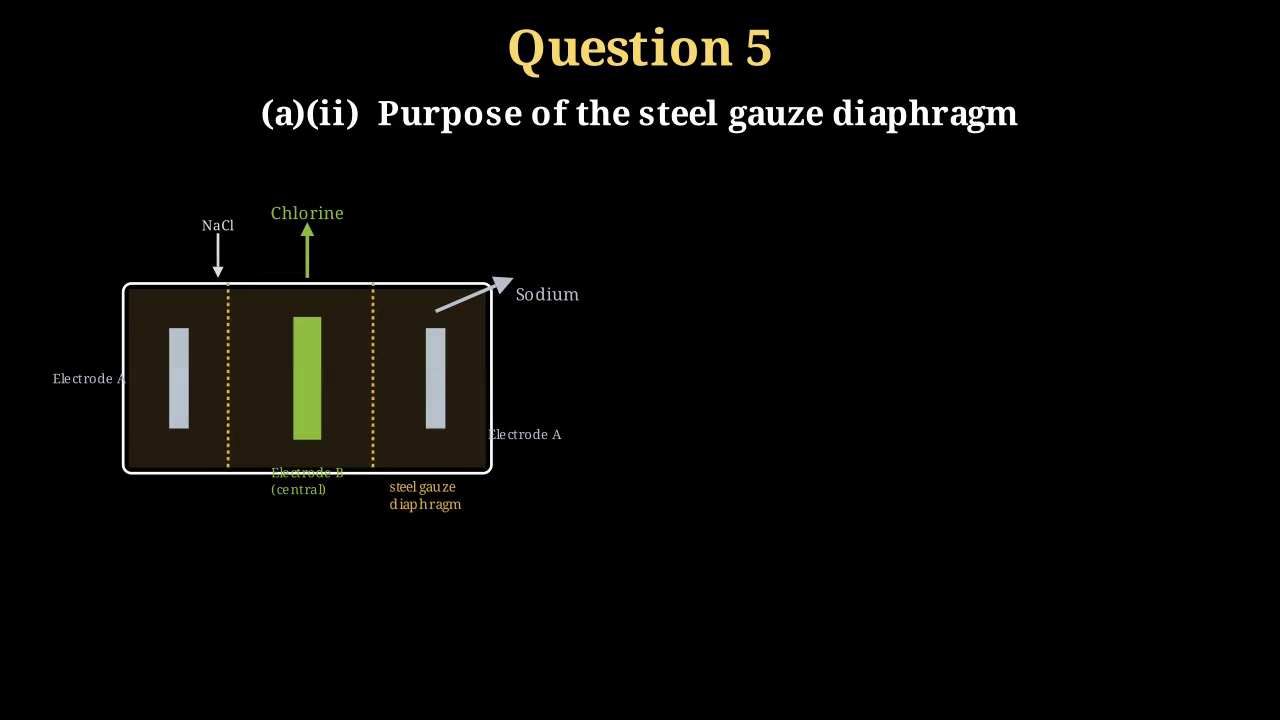
(b) Function of the steel-gauze diaphragm
Sodium and chlorine are produced very close to each other in the cell, and being highly reactive they would immediately combine back into sodium chloride. The steel-gauze diaphragm sits between the electrodes and keeps the two products physically apart, preventing them from recombining while still allowing ions through to complete the circuit.
(c)(i) How the cell runs at 600 °C instead of 801 °C
Pure sodium chloride melts at 801 °C, but calcium chloride is mixed in with it. Adding this impurity lowers the melting point of the mixture, so it becomes molten at around 600 °C rather than 801 °C. The molten mixture is what is electrolysed.
(c)(ii) Advantage of the lower operating temperature
A lower operating temperature is cheaper to maintain. Less heat is needed, so the cell saves fuel and cuts the electricity cost of keeping the electrolyte molten.
(c)(iii) State of the sodium produced
Compare the two temperatures. The cell runs at 600 °C while sodium melts at only 97.8 °C. Because the operating temperature is far above the melting point of sodium, the sodium is produced as a liquid — molten sodium — which then collects and is drawn off.
(d) How to store sodium
Sodium is extremely reactive: it reacts violently with water and tarnishes instantly in air. It is therefore stored submerged under oil or paraffin, which seals it away from moisture and oxygen so that it cannot react with them.
(e) Mass of sodium from 1000 kg of sodium chloride
From the electrode reactions, two moles of sodium chloride give two moles of sodium, so the mole ratio of NaCl to Na is 1 : 1. Work out the formula mass of sodium chloride, then take the sodium's share of that mass. The molar mass of NaCl is 23 + 35.5 = 58.5, and sodium accounts for 23 of it, so multiply 1000 kg by the fraction 23/58.5.
(f) One industrial use of sodium
Sodium has several industrial uses. It is used as a coolant in nuclear reactors (often as a sodium–potassium alloy for transferring heat), and in the orange sodium-vapour lamps that light streets. Any one of these earns the mark.
Final Result
Electrode B is the anode (chloride ions are oxidised to chlorine there) and electrode A is the cathode (sodium ions are reduced to sodium there). The steel-gauze diaphragm keeps the sodium and chlorine apart so they cannot recombine. Calcium chloride is added to lower the melting point so the cell runs at about 600 °C, which saves fuel and electricity. Since 600 °C is well above sodium's melting point of 97.8 °C, the sodium is produced molten (liquid). Sodium is stored under oil or paraffin to keep out air and moisture. From 1000 kg of NaCl the mass of sodium is (23/58.5) × 1000 = 393.16 kg. Sodium is used as a coolant in nuclear reactors.
Why this method works
Every part of this question is decided by two ideas working together: the electrode reactions of molten electrolysis, and the reactivity of the products. Oxidation (loss of electrons) always defines the anode and reduction (gain of electrons) the cathode, which is why chlorine gives the anode and sodium gives the cathode regardless of where they sit in the apparatus. Because both products are so reactive they must be kept apart (the diaphragm) and the sodium must be sealed from air and water (stored under oil). The temperature choices are pure economics — a melting-point depression lets the same chemistry run cooler and cheaper — and the state of the sodium simply follows from comparing the operating temperature with sodium's own melting point. The mass calculation rests on the 1 : 1 mole ratio, so the mass of sodium is just its fractional share of the salt's molar mass.
Check the mass calculation by proportion: sodium is 23/58.5 ≈ 0.393 of the mass of sodium chloride, and 0.393 × 1000 kg ≈ 393 kg, matching 393.16 kg.