KCSE 2025 Chemistry P2 Q7 — Rates of Reaction (Collision Theory and Tangents)
Published
The Question
“(a) For a reaction between gases, explain, in terms of collisions, the effect on the rate of reaction of (i) increasing the pressure and (ii) increasing the temperature. (b) Ethanoic acid was reacted with excess copper(II) carbonate and the volume of carbon dioxide given off was measured over time. (i) Write the balanced equation for the reaction. (ii) Explain why the copper(II) carbonate was in excess. (iii) Describe how the results are plotted on a graph. (iv) Using the graph, determine the rate of reaction at 10 s and at 40 s by drawing tangents. (v) Explain why the rate at 40 s is lower than the rate at 10 s.”
(a)(i) Effect of increasing the pressure
This is a gas reaction, so picture the gas particles in a container. Increasing the pressure squeezes the same number of particles into a smaller volume. Packed closer together, the particles are more concentrated and collide far more often, so there are more frequent effective collisions each second and the rate increases.
(a)(ii) Effect of increasing the temperature
Raising the temperature increases the rate for two reasons — give both for full marks. First, the particles gain kinetic energy, so they move faster and collide more often. Second, and more importantly, more of the particles now have energy equal to or above the activation energy — the minimum energy needed to react — so a much larger fraction of the collisions are successful.
(b)(i) Equation for ethanoic acid and copper(II) carbonate
This is an acid reacting with a carbonate, so the products are a salt, water and carbon dioxide. The salt is copper(II) ethanoate, and the carbon dioxide is the gas whose volume is measured over time.
(b)(ii) Why the copper(II) carbonate is in excess
The copper(II) carbonate is in excess so that all of the ethanoic acid is completely used up. The acid is the reactant being studied, and having plenty of solid carbonate present makes sure none of the acid is left over at the end.
(b)(iii) Plotting the results
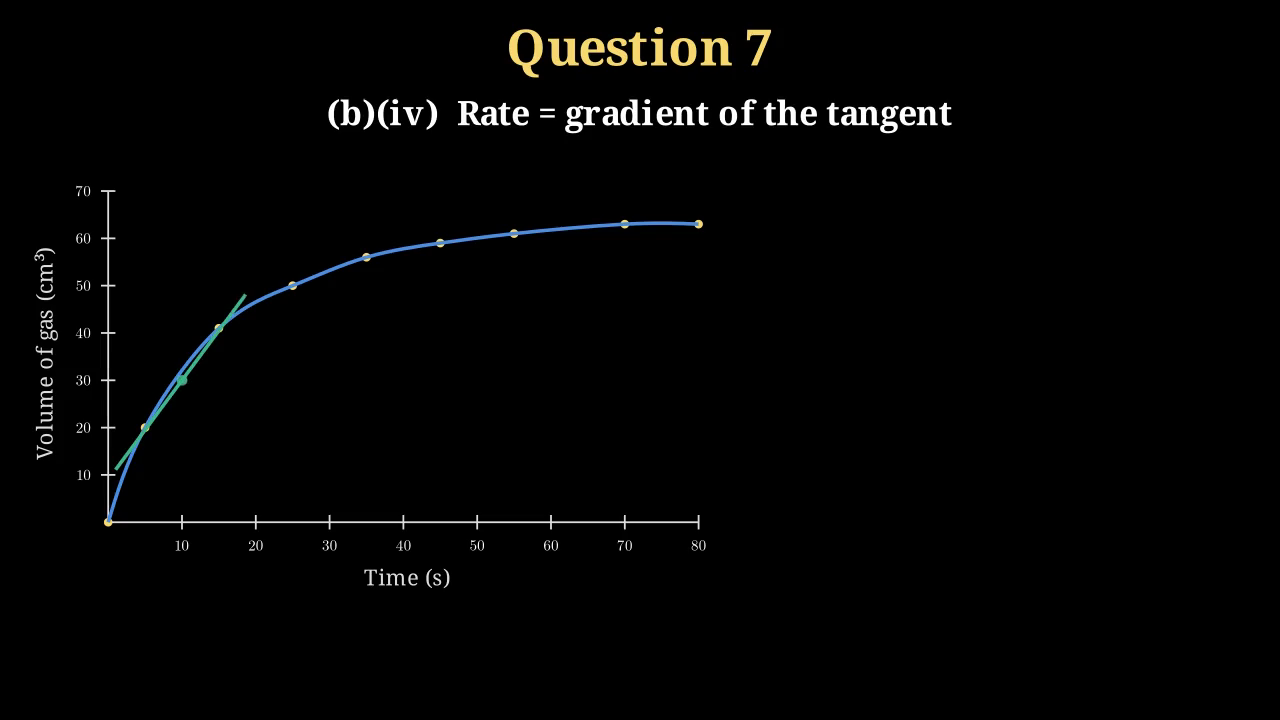
Time goes on the x-axis and the volume of gas on the y-axis. Choose a sensible, even scale that fills the grid, plot each point from the table, and then draw a single smooth curve through the points — not a dot-to-dot line. The curve climbs steeply at first and then flattens off as the reaction slows down and finishes.
(b)(iv) Rate at 10 s and 40 s from tangents
The rate at any instant is the gradient of the tangent to the curve at that time. At 10 s, draw a tangent touching the curve and measure its slope — the change in volume divided by the change in time — which gives about 2.1 cm³/s, steep because the reaction is fast early on. At 40 s, draw another tangent; this one is much shallower, giving a gradient of only about 0.3 cm³/s, showing the reaction has slowed right down.
(b)(v) Why the rate falls with time
As the reaction proceeds, the ethanoic acid is used up, so its concentration falls. With fewer acid particles in the same volume, there are fewer effective collisions each second, so the rate at 40 s is lower than at 10 s. It all comes back to how often the particles collide successfully.
Final Result
Increasing the pressure packs the gas particles closer together, so they collide more often and the rate rises. Increasing the temperature makes particles move faster and, more importantly, gives more of them at least the activation energy, so more collisions succeed and the rate rises. The reaction is 2CH₃COOH(aq) + CuCO₃(s) → (CH₃COO)₂Cu(aq) + H₂O(l) + CO₂(g); the copper(II) carbonate is in excess so all the acid reacts. Plot volume of gas (y) against time (x) and draw a smooth curve. The rate is the gradient of the tangent: about 2.1 cm³/s at 10 s and about 0.3 cm³/s at 40 s. The rate is lower at 40 s because the acid concentration has fallen as it is used up, giving fewer effective collisions per second.
Why this method works
Every part of this question is an application of collision theory: a reaction only speeds up when the reacting particles collide more often, or when a greater share of those collisions carries enough energy to react. Pressure and concentration change the frequency of collisions (how crowded the particles are), while temperature does both — it raises the collision frequency a little and, crucially, pushes many more particles over the activation-energy barrier. The falling rate over time is the same idea running in reverse: as the acid is consumed its concentration drops, collisions become less frequent, and the curve flattens. Reading the rate as the gradient of a tangent turns that qualitative slowing-down into a number, which is why the steep early tangent gives a large rate and the shallow late tangent a small one.
The two tangent gradients agree with the shape of the curve: a steep slope early on (≈2.1 cm³/s) and a much shallower slope later (≈0.3 cm³/s), consistent with a reaction that starts fast and slows as the acid runs out.