KCSE 2025 Physics P1 Q10 — Bernoulli Effect (dust trail behind a vehicle)
Published
The Question
“A vehicle speeding along a dusty road leaves a trail of dust that rises high above the ground. Explain this observation.”
Look at the air behind the vehicle
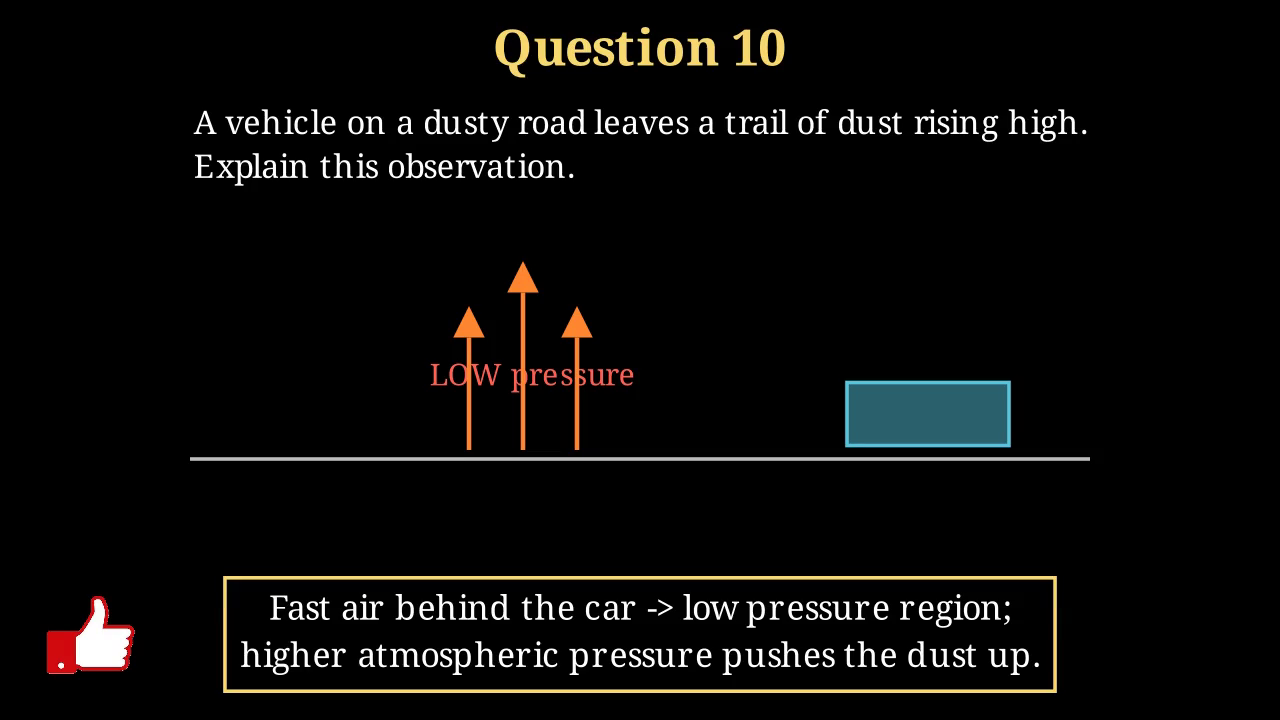
As the vehicle rushes forward it leaves a gap behind it, and air moves very fast into the wake to fill that gap. By Bernoulli's principle, fast-moving air exerts low pressure, so a low-pressure region forms in the wake directly behind the car.
Compare the pressures and follow the dust
The surrounding air, further from the vehicle, is still at the higher normal atmospheric pressure. Because pressure always pushes from high to low, this higher atmospheric pressure drives the dust from the road surface upward into the low-pressure zone in the wake, so the trail is lifted high above the ground.
Final Result
The fast air rushing in behind the vehicle forms a low-pressure region (Bernoulli's principle). The higher surrounding atmospheric pressure then pushes the dust up into that low-pressure wake, lifting the trail high above the road.
Why this method works
Bernoulli's principle states that where a fluid flows faster, its pressure is lower. A speeding vehicle drags the air immediately behind it into rapid motion to fill the space it vacates, so the pressure in that wake drops below normal. The dust is not sucked up by the low pressure itself; rather, the ordinary atmospheric pressure surrounding the wake is now greater than the pressure inside it, and a fluid always experiences a net push from the high-pressure side toward the low-pressure side. That net upward push is what carries the dust off the road and holds it high in the moving stream of air. The same pressure-difference idea explains why roofs are lifted in strong winds and why aerofoils generate lift.
The effect strengthens as the vehicle goes faster: greater speed means faster wake air, an even lower pressure, a bigger pressure difference, and dust that rises higher.