KCSE 2025 Physics P1 Q2 — Tree Height from Shadows (Similar Triangles)
Published
The Question
“Students want to cut down a tree safely so that it does not fall on nearby houses, and they need to estimate its height first. Using the known height of one student, describe how the height of the tree can be estimated, and derive the expression for the tree's height.”
Set up two similar triangles with shadows
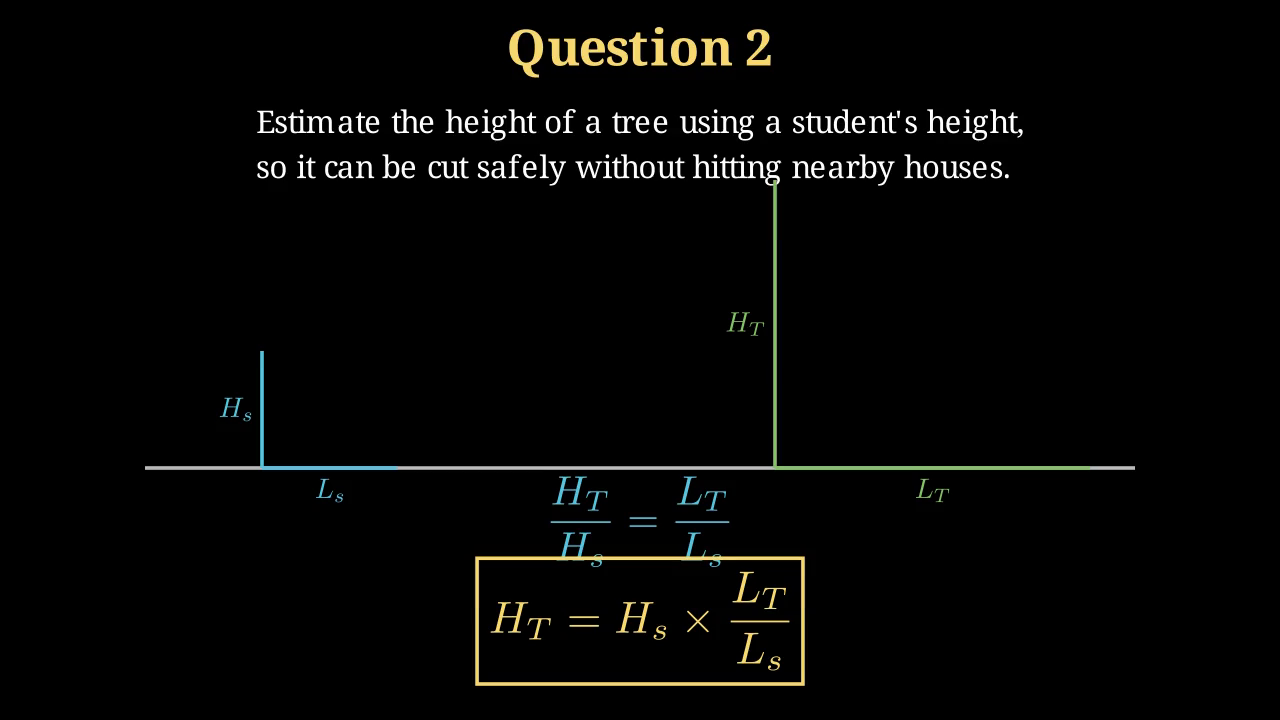
Measure the student's height and the length of the student's shadow, and at the same moment measure the length of the tree's shadow. Because the Sun's rays strike both the student and the tree at the same angle, the student with their shadow and the tree with its shadow form two similar triangles. Corresponding sides of similar triangles are in equal ratio, so the height-to-shadow ratio is the same for both.
Make the tree's height the subject
Rearrange the equal-ratio relationship to isolate the tree's height. Multiplying the student's height by the ratio of the tree's shadow to the student's shadow gives the height of the tree. All three lengths on the right are easy to measure on the ground with a tape.
Final Result
The tree's height is H_T = H_s × (L_T / L_s), where H_s is the student's height, L_s the student's shadow length and L_T the tree's shadow length. Measure the three lengths and multiply to get the tree's height.
Why this method works
The method works because sunlight from the distant Sun arrives in effectively parallel rays, so at any one instant every upright object casts its shadow at the same angle of elevation. That shared angle, together with the right angle each object makes with the flat ground, means the student-and-shadow triangle and the tree-and-shadow triangle have the same angles — they are similar. Similar triangles keep the ratio of corresponding sides constant, so the tall, hard-to-reach tree can be scaled directly from the short, easily measured student. The timing matters: the shadows must be measured at the same moment, because as the Sun moves the angle changes and the ratio would no longer hold.
Sanity check with numbers: if the student is 1.5 m tall casting a 1 m shadow while the tree casts a 6 m shadow, then H_T = 1.5 × 6/1 = 9 m — a believable tree height.