KCSE 2025 Physics P1 Q3 — Tension in a Loaded Plank (Direction of Force)
Published
The Question
“A heavy block rests on the middle of a plank that is supported at its two ends by pivots. The plank bends slightly under the load. On a diagram, show how the tensional force acts on the plank.”
See why the plank bows downwards
The weight of the block presses down on the middle of the plank, while the two pivots hold up the ends. This makes the plank bend, curving downwards in the middle. As it bends, the material on the underside of the plank is stretched, because the lower surface has to follow a longer, more curved path than the top.
Read the tension off the stretched lower fibres
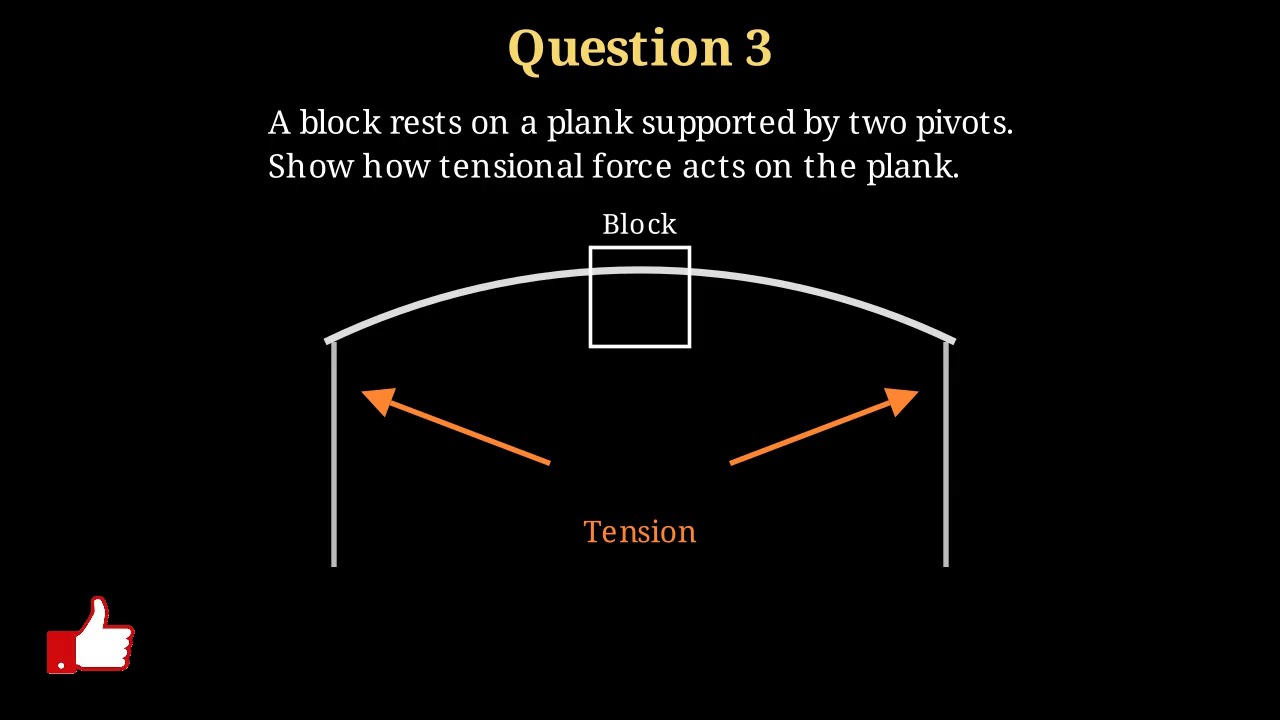
Whenever the fibres of a material are stretched, they resist by pulling back — that inward pull is tension. The stretched fibres run along the length of the plank, so the tensional force also acts along the plank. It is directed outwards along the lower surface, pulling toward each pivot on either side of the load. The orange arrows on the diagram point outward along the bottom of the plank, away from the block and toward the supports, showing the direction of this tension.
Final Result
The tension acts along the plank. The load makes the plank bow down, stretching the lower fibres, so tension pulls outward along the lower surface toward each pivot — shown by arrows pointing outward, away from the block, on either side.
Why this method works
A bending beam is not stretched or squeezed uniformly; the two surfaces behave in opposite ways. On the concave upper side the fibres are pushed together and are in compression, while on the convex lower side the fibres are pulled apart and are in tension. Tension is a pulling force that always acts along the line of the stretched material and points back toward the material trying to close the stretch, which is why the arrows lie along the plank and point outward toward the supports rather than up or down. Recognising which surface stretches and which compresses is the key to marking the direction of these internal forces correctly.
Consistency check: the upper surface, being squeezed, would carry the opposite force — compression acting inward along the plank — confirming that the stretched lower surface is where the tension lies.